Overview
Second Brain turns raw saved content into structured, searchable knowledge. Instead of keeping information scattered across tabs, bookmarks, docs, and social posts, the app centralizes it and makes it easier to resurface later.
Second Brain is a full-stack knowledge workspace that helps users save links, videos, documents, and notes in one place, then organize and retrieve them with AI-assisted search and summaries.

Second Brain turns raw saved content into structured, searchable knowledge. Instead of keeping information scattered across tabs, bookmarks, docs, and social posts, the app centralizes it and makes it easier to resurface later.
Most people store knowledge across browser tabs, bookmarks, docs, and social platforms. Traditional bookmark tools are static: they do not summarize content, connect related ideas, or make retrieval easy when memory fades.
Users need a system that can capture content quickly and surface the right context later.
Build a scalable personal knowledge platform that supports fast content capture, secure authentication, semantic retrieval, AI-generated summaries and insights, and controlled sharing across private, link-based, and public modes.
The platform stores user content in MongoDB, generates embeddings, and runs background AI processing through a queue worker. On the frontend, React Query powers data fetching and optimistic updates, while semantic search and AI insight panels help users move from saved link to usable knowledge.
The product is designed around a capture-first workflow with AI assisted retrieval.
The stack was chosen to balance product speed, AI flexibility, and maintainability.
The system is built around a simple request then enrich workflow so users never wait on heavy AI tasks.
The hardest part was making AI retrieval dependable without forcing ideal-path assumptions.
The app emphasizes responsive feedback and avoids wasted work wherever possible.
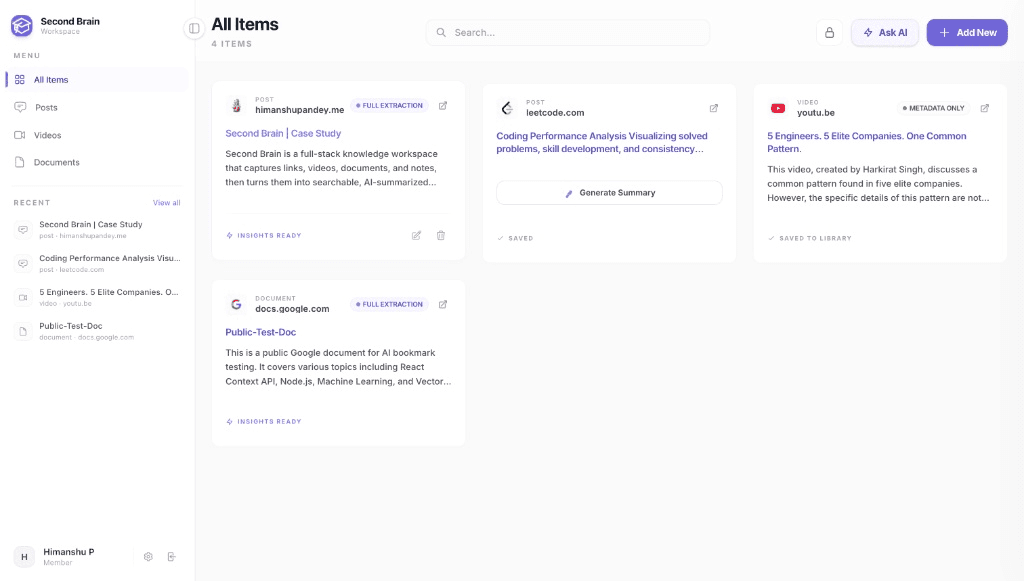
The interface was designed around a single dashboard so users could stay in one place while moving from capture to insight.
Security was handled with the usual production basics plus a few content-specific controls.
The final result is a production-ready full-stack knowledge app with AI-assisted retrieval and synthesis.
The project reinforced that production AI needs reliable fallback paths and clear UX, not just ideal model calls.
The current foundation is strong, but there is room to push discovery, analytics, and collaboration further.
The app is deployed as a split production system so the UI can stay fast while background AI work remains isolated.